

The Commonwealth Games is a world class, multi-sport event that is held once every four years.
The Glasgow 2026 Commonwealth Games will be held from 23 July - 2 August, promising an exciting 11 days of sport.
From the first lift to the final medal session, fans can watch the Commonwealth Games weightlifting and para powerlifting competitions live. Tickets are available through the official Commonwealth Games website, where you'll also find venue information, session details and event updates.

Discover the full roster of Para Powerlifters and Weightlifters taking to the platform representing England, Northern Ireland, Scotland, Wales, Gibraltar, Jersey and the Isle of Man:
Friday 24 July
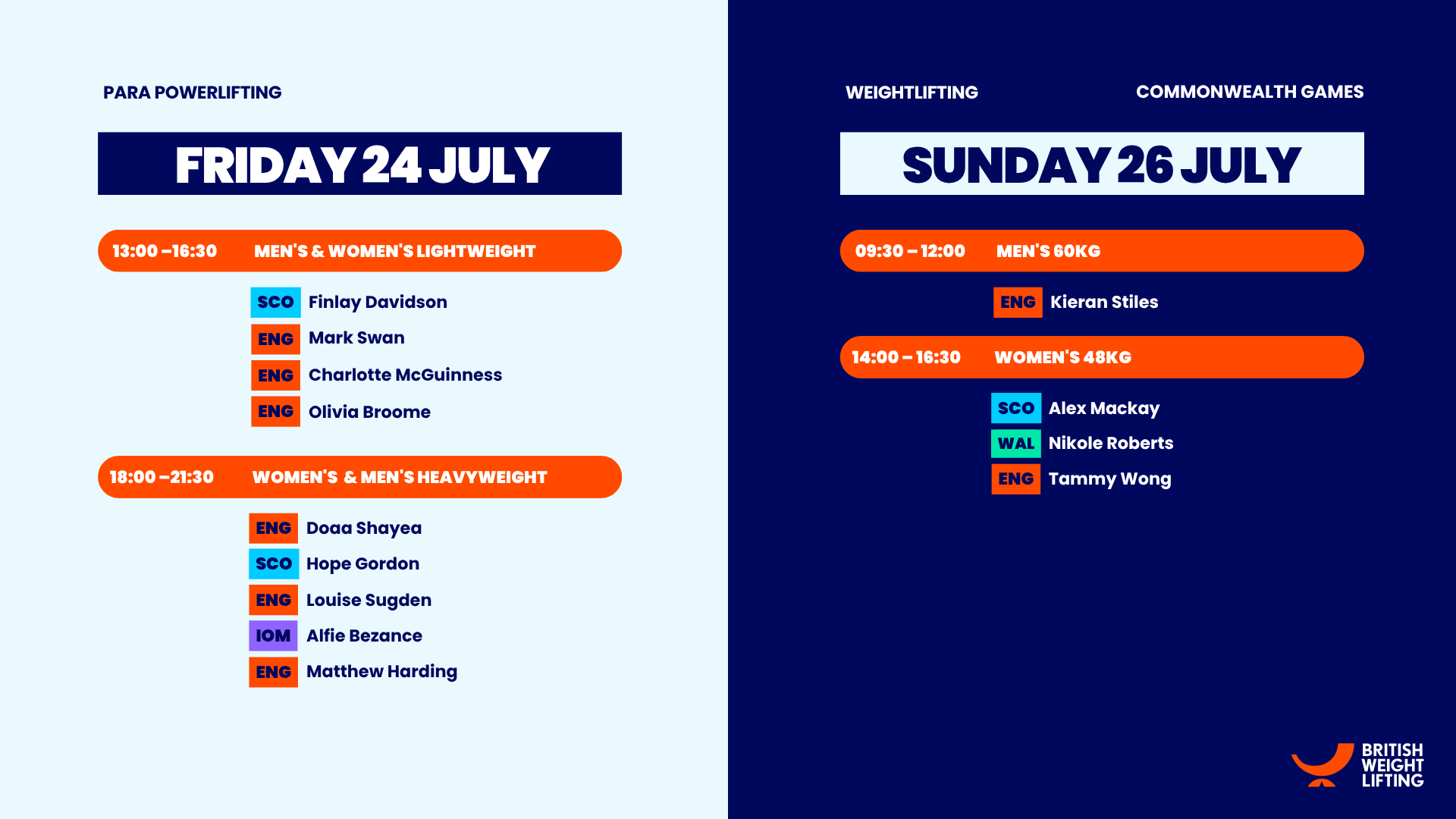
13:00–16:30 | Men's Lightweight & Women's Lightweight Para Powerlifting
- Finlay Davidson (Scotland)
- Mark Swan (England)
- Charlotte McGuinness (England)
- Olivia Broome (England)
18:00–21:30 | Women's Heavyweight & Men's Heavyweight Para Powerlifting
- Doaa Shayea (England)
- Hope Gordon (Scotland)
- Louise Sugden (England)
- Alfie Bezance (Isle of Man)
- Matthew Harding (England)
Sunday 26 July
09:30–12:00 | Men's 60kg
- Kieran Stiles (England)
14:00–16:30 | Women's 48kg
- Alex Mackay (Scotland)
- Nikole Roberts (Wales)
- Tammy Wong (England)
18:30–21:00 | Men's 65kg
Monday 27 July
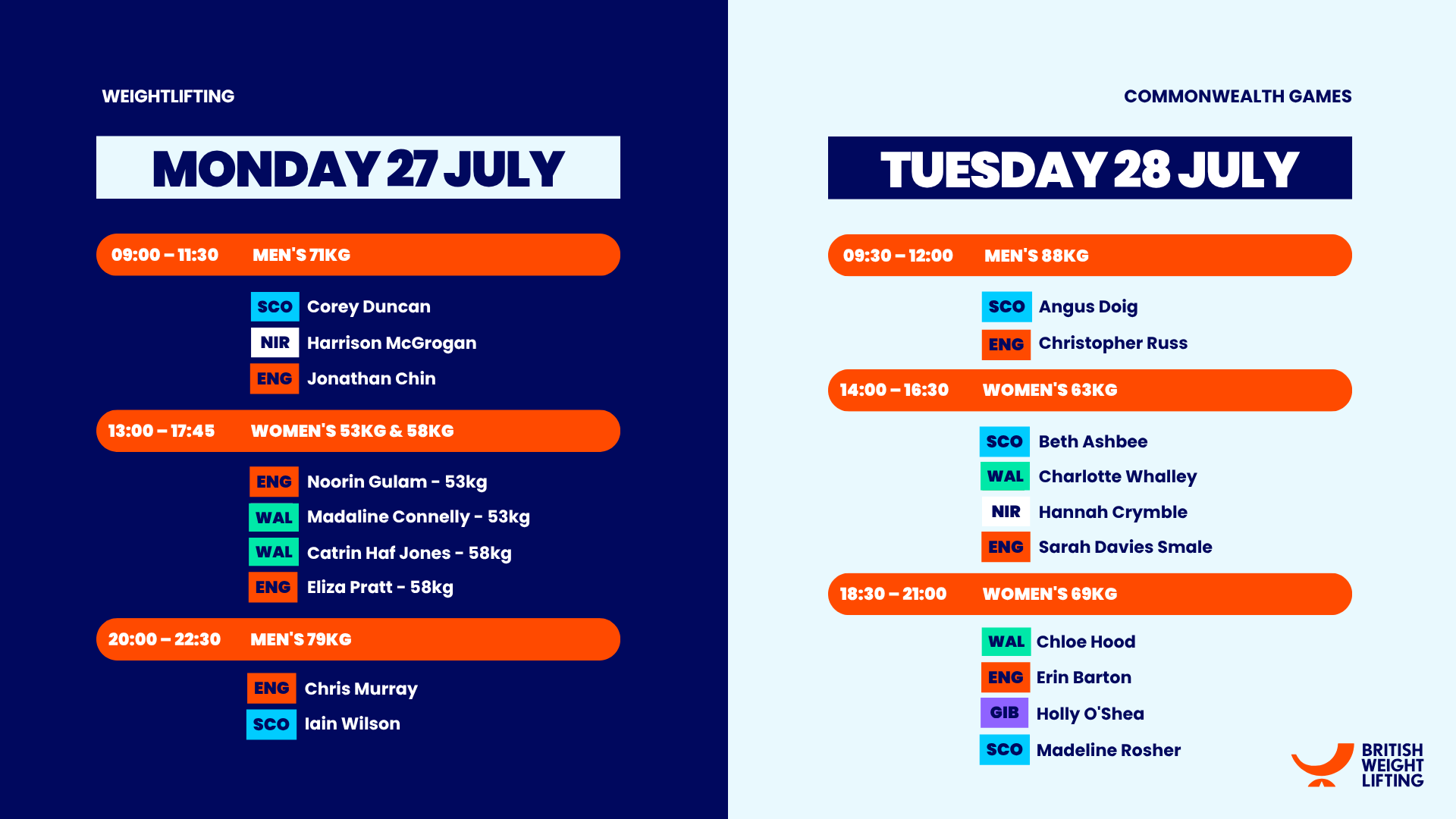
09:00–11:30 | Men's 71kg
- Corey Duncan (Scotland)
- Harrison McGrogan (Northern Ireland)
- Jonathan Chin (England)
13:00–17:45 | Women's 53kg & 58kg
- Catrin Haf Jones (Wales)
- Eliza Pratt (England)
- Madaline Connelly (Wales)
- Noorin Gulam (England)
20:00–22:30 | Men's 79kg
- Chris Murray (England)
- Iain Wilson (Scotland)
Tuesday 28 July
09:30–12:00 | Men's 88kg
- Angus Doig (Scotland)
- Christopher Russ (England)
14:00–16:30 | Women's 63kg
- Beth Ashbee (Scotland)
- Charlotte Whalley (Wales)
- Hannah Crymble (Northern Ireland)
- Sarah Davies Smale (England)
18:30–21:00 | Women's 69kg
- Chloe Hood (Wales)
- Erin Barton (England)
- Holly O'Shea (Gibraltar)
- Madeline Rosher (Scotland)
Wednesday 29 July
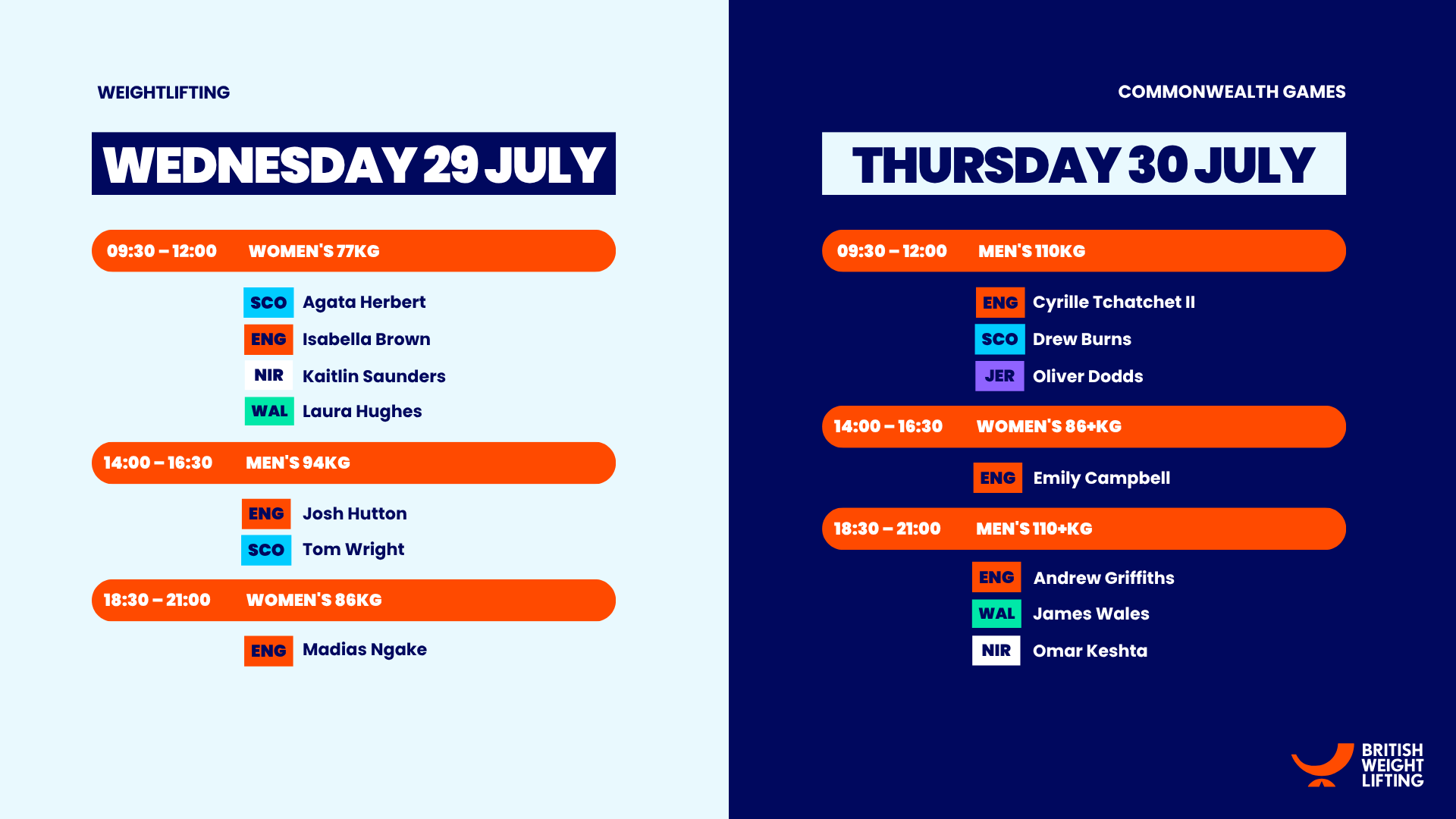
09:30–12:00 | Women's 77kg
- Agata Herbert (Scotland)
- Isabella Brown (England)
- Kaitlin Saunders (Northern Ireland)
- Laura Hughes (Wales)
14:00–16:30 | Men's 94kg
- Josh Hutton (England)
- Tom Wright (Scotland)
18:30–21:00 | Women's 86kg
- Madias Ngake (England)
Thursday 30 July
09:30–12:00 | Men's 110kg
- Cyrille Tchatchet II (England)
- Drew Burns (Scotland)
- Oliver Dodds (Jersey)
14:00–16:30 | Women's 86+kg
- Emily Campbell (England)
18:30–21:00 | Men's 110+kg
- Andrew Griffiths (England)
- James Wales (Wales)
- Omar Keshta (Northern Ireland)
.png)
Read about how the sports of weightlifting and para powerlifting work before you catch the action at the competition!
Strength. Skill. Strategy.
Weightlifting is one of the Commonwealth Games’ most exciting sports. Athletes compete across a range of bodyweight categories, battling for medals with every lift.
Success isn't just about strength. It's about precision, confidence and making the right decisions under pressure. Every attempt matters.
Athletes compete in two disciplines:
The Snatch
In the snatch, athletes lift the barbell from the floor to overhead in one continuous movement. It demands speed, technique and control.
The Clean and Jerk
The clean and jerk is a two-part lift. Athletes first bring the barbell to their shoulders (the clean), before driving it overhead (the jerk).
How the Competition Works
Each athlete has:
- Three snatch attempts
- Three clean and jerk attempts
The weight on the bar increases throughout the competition. Athletes and coaches must carefully select their attempts, balancing ambition with strategy as the competition unfolds.
The athlete with the highest combined total from their best snatch and best clean and jerk is crowned the winner.
Pure upper-body strength on the Commonwealth stage.
Para powerlifting is one of the most impressive displays of strength in sport. Athletes compete in the bench press, lifting the maximum weight they can under strict technical rules.
To complete a successful lift, athletes must:
- Lower the bar to their chest.
- Hold it motionless.
- Press it to full arm extension with locked elbows.
- Demonstrate control until the referees signal completion.
Judging the Lift
Three international referees judge every attempt.
- Two or three white lights = successful lift
- Two or three red lights = unsuccessful lift
How the Competition Works
Each athlete is given three attempts.
The athlete with the heaviest successful lift wins.
In certain circumstances, a fourth attempt may be awarded for a world record. While a successful record lift is recognised, it doesn't affect the competition standings.
Classification
All athletes competing in para powerlifting have an eligible impairment affecting their lower limbs or hips.
Unlike many para sports, athletes are not grouped into multiple sport classes. Instead, competition is organised by gender and bodyweight category.
Strength Beyond Expectation
Para powerlifters regularly lift extraordinary weights, with some athletes pressing more than three times their own bodyweight.
It's a sport that combines strength, technique and determination. And one that continues to inspire audiences across the Commonwealth.
.png)
Health benefits of lifting weights
There are enormous benefits to introducing weights to your lifestyle. Feeling physically stronger is one of them. And the best part is, you don’t have to lift heavy weights to start feeling these benefits. Even low-level weights as part of your weekly routine will help you to see positive change to your physical and mental wellbeing.
Want to learn more about weightlifting?
Our NEW Introduction to Weightlifting online course is just £10 (limited time offer)
Discover the history and benefits of Olympic weightlifting, learn the fundamentals of the snatch, clean and jerk, and build a personalised training programme that fits your goals and lifestyle. Along the way, you'll gain practical knowledge, develop key movement skills and access a library of 50 exercises to support your progress.
Suitable for beginners of all ages and abilities, this course is your first step towards finding your strong.
Book here
Learn to lift with our practical workshops
Our practical workshops are perfect for those looking to master the effective technique of the Olympic lifts - the snatch, the clean, the jerk.
Ready to lift?
Find a local club with our club finder tool.
Partners
-
 Official Partner
-
 Official Equipment Partner
-
 Official Photography Agency
-
 Official Partner
-
 Official Partner
-
 Official Partner
-
 Official Travel Partner
-
 Partner
-
 Funding Partner
-
 Funding Partner
-
 Funding Partner
-
 Official Strategic Partner
-
 Official Strategic Partner
-
 Official Strategic Partner
-
 Weight Lifting Foundation Charity
-
 Official ELearning Partner
-
 Official Awarding Organisation
-
 Official Course Endorsement


c/o Affinia 3rd Floor Chancery House St Nicholas Way Sutton Surrey SM1 1JB
Website designed and developed by 93FT in partnership with Sport80.
