

Children are not miniature adults: Outlining key differences between youth and adult athletes.
In this article, we explore the key differences between children and adults.Understanding this helps coaches take a more informed, effective approach when working with youth athletes.
Once you’ve read the article, we invite you to complete the knowledge checks and coach development activity. These will help you put learning into practice.
.png)
“Children are not miniature adults.”
This statement highlights a key point: adult-based training programmes should not be directly applied to young athletes.
Children differ in their:
- fluctuating physical size
- rate of growth and maturation
- physical function
- responses to acute and chronic exercise
They also differ in psychological and social development. Because of this, youth training programmes should always reflect these differences between children and adults.
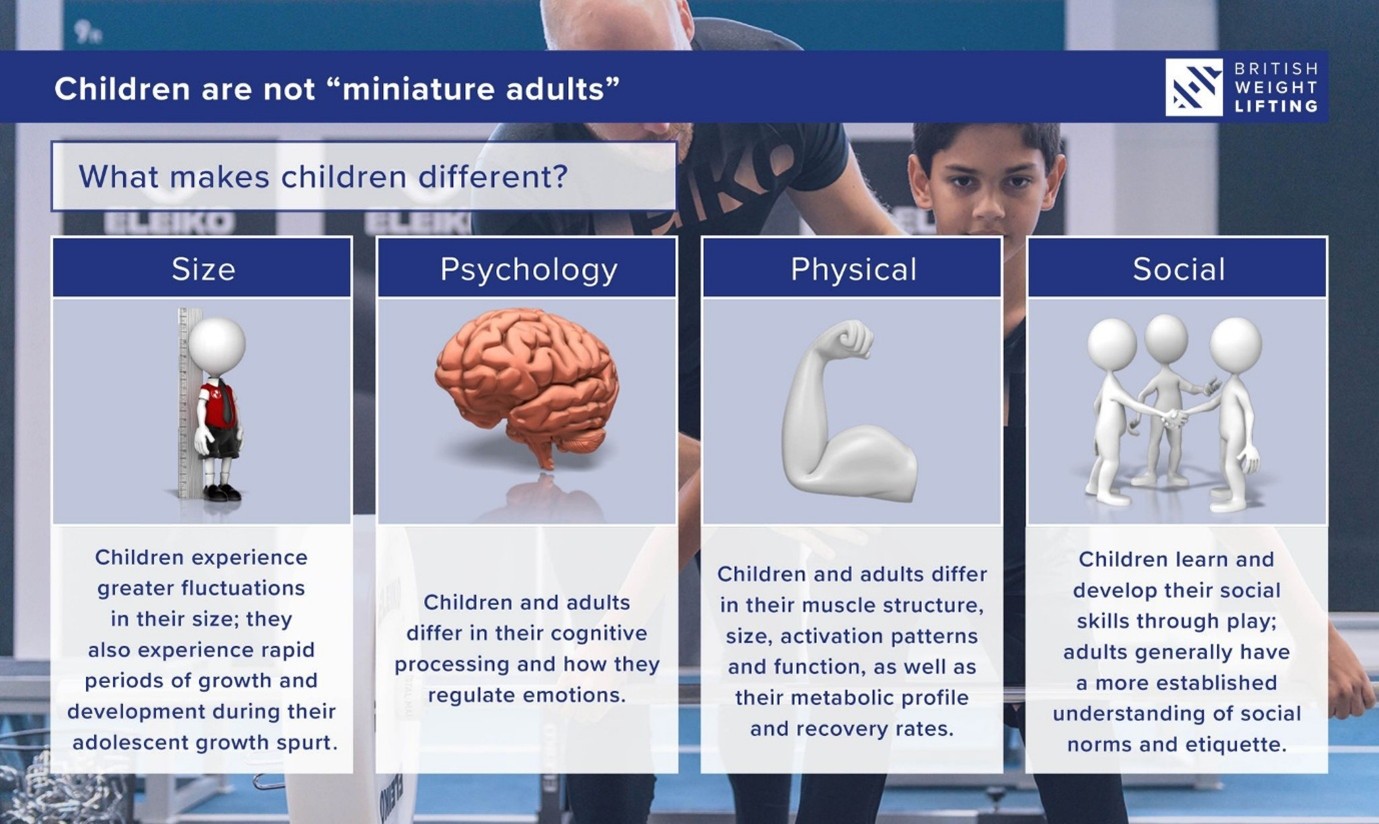
So, what makes children different?
Size
Compared with adults, children experience greater fluctuations in size.
They also go through rapid periods of growth and development, especially during the adolescent growth spurt.
Psychology
Children and adults typically think in different ways.
Children tend to think more concretely (thinking literally), while adults can use abstract thinking and reasoning.
There are also differences in emotional regulation. Children often rely on external support or simple strategies to manage emotions, while adults can use more advanced internal strategies, such as rethinking a situation to change how they feel.
Physical
The NSCA Position Statement on Long-Term Athletic Development (Lloyd et al., 2016) highlights key physiological differences between children and adults, stating:
- Children and adults ‘differ in their muscle structure, size, activation patterns and function. These differences will typically predispose children to reduced force-producing or force-attenuating capabilities.
- Children’s metabolic profile is more conducive to oxidative metabolism.
- Recovery rates from high-intensity exercise are shorter in youth than in adults.
Social
Children are still developing their social skills, often through play.
Adults generally have a more established understanding of social norms and etiquette.
Key point
“The content and delivery of youth strength and conditioning provision should be markedly different from that of fully matured adults” (Lloyd and Oliver, 2012).
Knowledge check…
The questions below are designed to help you consolidate what you have learned, by retrieving information from your memory (rather than just passively reading something).
1.True or false?
Compared with adults, children experience greater fluctuations in their size and rate of growth…
- Select the correct answer from the options below.
Typically, children engage in __________ thinking and reasoning.
- a) concrete
- b) abstract
3.Select the correct answer from the options below.
Differences in their muscle makeup typically predispose children to __________ force-producing or force-attenuating capabilities when compared to adults.
- a) reduced
- b) increased
4.True or false?
Children’s metabolic profile is more conducive to anaerobic metabolism…
5.Which of the statements below, relating to typical social differences between children and adults, are accurate? (Select the correct option[s])
- a) Children learn and develop their social skills through play
- b) Children will generally have a more established understanding of social norms and etiquette
- c) Adults will generally have a more established understanding of social norms and etiquette
Coach development activity
Take a moment to reflect on the prompt below.
How might you differ in the way you approach coaching youth athletes and adults?
Further info:
This article has been adapted from content in the Growth, Maturation and Child Development module, which forms part of the British Weight Lifting Level 3 Certificate in Coaching Youth Weightlifting course.
Answers to knowledge checks…
- True
- a
- a
- False
- a and c
References
Lloyd, R., Cronin, J., Faigenbaum, A., Haff, G., Howard, R., Kraemer, W., Micheli, L., Myer, G. and Oliver, J. (2016). National Strength and Conditioning Association Position Statement on Long-Term Athletic Development. J Strength Cond Res. 2016 Jun;30(6):1491–509.
Lloyd, R. and Oliver, J. (2012) The Youth Physical Development Model: A New Approach to Long-Term Athletic Development.
Partners
-
 Official Partner
-
 Official Equipment Partner
-
 Official Photography Agency
-
 Official Partner
-
 Official Partner
-
 Official Partner
-
 Official Travel Partner
-
 Partner
-
 Funding Partner
-
 Funding Partner
-
 Funding Partner
-
 Official Strategic Partner
-
 Official Strategic Partner
-
 Official Strategic Partner
-
 Weight Lifting Foundation Charity
-
 Official ELearning Partner
-
 Official Awarding Organisation
-
 Official Course Endorsement


c/o Affinia 3rd Floor Chancery House St Nicholas Way Sutton Surrey SM1 1JB
Website designed and developed by 93FT in partnership with Sport80.
