

BWL Launches NEW Level 3 Youth Coaching Qualification to Support Safe, Effective and Inclusive Development for Young People
British Weight Lifting (BWL) has launched a new specialist coaching qualification designed to elevate the standard of youth training across the UK.
The Level 3 Certificate in Coaching Youth Weightlifting equips coaches with the skills, knowledge and confidence to support children and adolescents through safe, developmentally appropriate weightlifting.
.png)
Why the qualification was developed
The course responds to several sector needs:
- A growing demand for specialist youth training expertise
Coaches across schools, community clubs and talent pathways have increasingly sought evidence-based guidance on how to support young lifters safely and effectively.
- The need to combat myths and provide clarity on youth strength training
Weightlifting for youth is often misunderstood. BWL’s youth proposition clearly states that when coached properly, weightlifting is safe, technically beneficial and developmentally appropriate. This qualification provides coaches with the knowledge to apply this safely in practice.
Read the full youth proposition statement here
- A commitment to inclusive, holistic development for youth athletes
Children are not miniature adults. Maximising their development requires an understanding of growth, maturation, psychology, safeguarding, recovery, nutrition and talent development. The Level 3 course embeds all of this.
What the course delivers
The 15-module programme covers safeguarding, technical development, talent environments, physiological development, injury risk reduction, coaching effectiveness, psychological factors, nutrition, recovery and much more.
Coaches will also complete a detailed case study involving a youth athlete, enabling them to apply long-term planning skills in a realistic coaching scenario.
The result? More confident, knowledgeable and child-centred coaches - and safer, more positive experiences for young lifters.
Supporting young people to thrive
BWL strongly endorses weightlifting as a tool for building strength, speed, power, movement skills, posture and confidence in youth. Through this qualification, BWL aims to empower more coaches to deliver these benefits in schools, clubs and community settings.
BWL also continues to encourage physical education departments and youth sport organisations to engage with weightlifting as part of a rich, varied activity offer that supports healthy development.
Enrolment now open
The Level 3 Certificate in Coaching Youth Weightlifting is now available for booking.
Coaches can access full course details and upcoming dates through the BWL booking platform.
Additional information:
Position statements relevant to the safety of youth resistance training
Historically, there have been concerns over youth engaging in weight training (inclusive of weightlifting) and associated injury risk.
However, leading position statements advocating the relative safety of youth resistance training have been published by British Weight Lifting (BWL), the UK Strength and Conditioning Association (UKSCA), British Association of Sport and Exercise Sciences (BASES), Australian Strength and Conditioning Association (ASCA), National Strength and Conditioning Association (NSCA) and the Canadian Society of Exercise Physiology (CSEP). In addition, in 2014 an international position statement was published, which was endorsed by 10 leading authorities from the fields of strength and conditioning, paediatric exercise science, sports science and sports medicine.
Similarly, the need for children to engage in ‘muscle strengthening’ activity 2-3 times per week is currently recommended by the World Health Organisation (WHO).
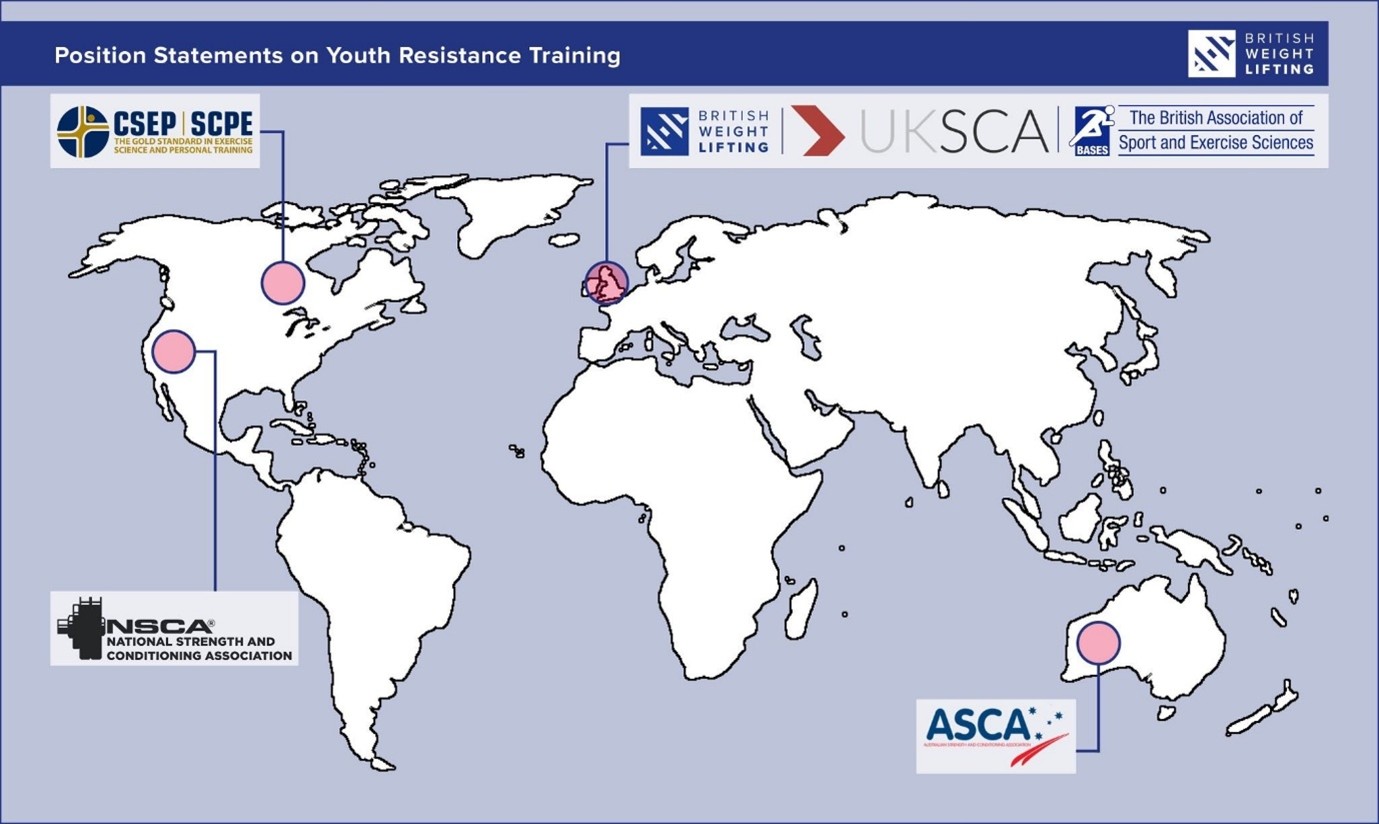
British Weight Lifting (BWL)
BWL are the national governing body for weightlifting and para powerlifting in the UK. As an NGB, BWL provide education and guidance around weightlifting and strength-oriented activity.
Click here to view the British Weight Lifting Position Statement.
Australian Strength and Conditioning Association (ASCA)
The ASCA is the accrediting body for strength and conditioning coaches in Australia as recognised by the Australian Sports Commission.
Click here to access the ASCA Position Stand (Resistance Training for Children and Youth).
British Association of Sport and Exercise Sciences (BASES)
BASES is a professional body that provides support and guidance for practitioners working in the fields of sport and exercise sciences. They contribute to the scientific basis for exercise recommendations in the UK and help shape policy and decisions.
Canadian Society for Exercise Physiology (CSEP)
According to their website, the CSEP ‘is a national voluntary organisation composed of professionals interested and involved in the scientific study of exercise physiology, exercise biochemistry, fitness, and health.’
Click here to access the Canadian Society for Exercise Physiology position paper.
National Strength and Conditioning Association (NSCA)
The NSCA is a nonprofit association that according to their website, is ‘dedicated to advancing the strength and conditioning and related sport science professions around the world.’
UK Strength and Conditioning Association (UKSCA)
The UKSCA is a professional body that provides scientific information, research as well as testing and accreditation in strength and conditioning. They also outline guidelines to the implementation and ethical practices of coaches who work within a strength and conditioning-based role.
Click here to access the UK Strength and Conditioning Association website.
Partners
-
 Official Partner
-
 Official Equipment Partner
-
 Official Photography Agency
-
 Official Partner
-
 Official Partner
-
 Official Partner
-
 Official Travel Partner
-
 Partner
-
 Funding Partner
-
 Funding Partner
-
 Funding Partner
-
 Official Strategic Partner
-
 Official Strategic Partner
-
 Official Strategic Partner
-
 Weight Lifting Foundation Charity
-
 Official ELearning Partner
-
 Official Awarding Organisation
-
 Official Course Endorsement


c/o Affinia 3rd Floor Chancery House St Nicholas Way Sutton Surrey SM1 1JB
Website designed and developed by 93FT in partnership with Sport80.
